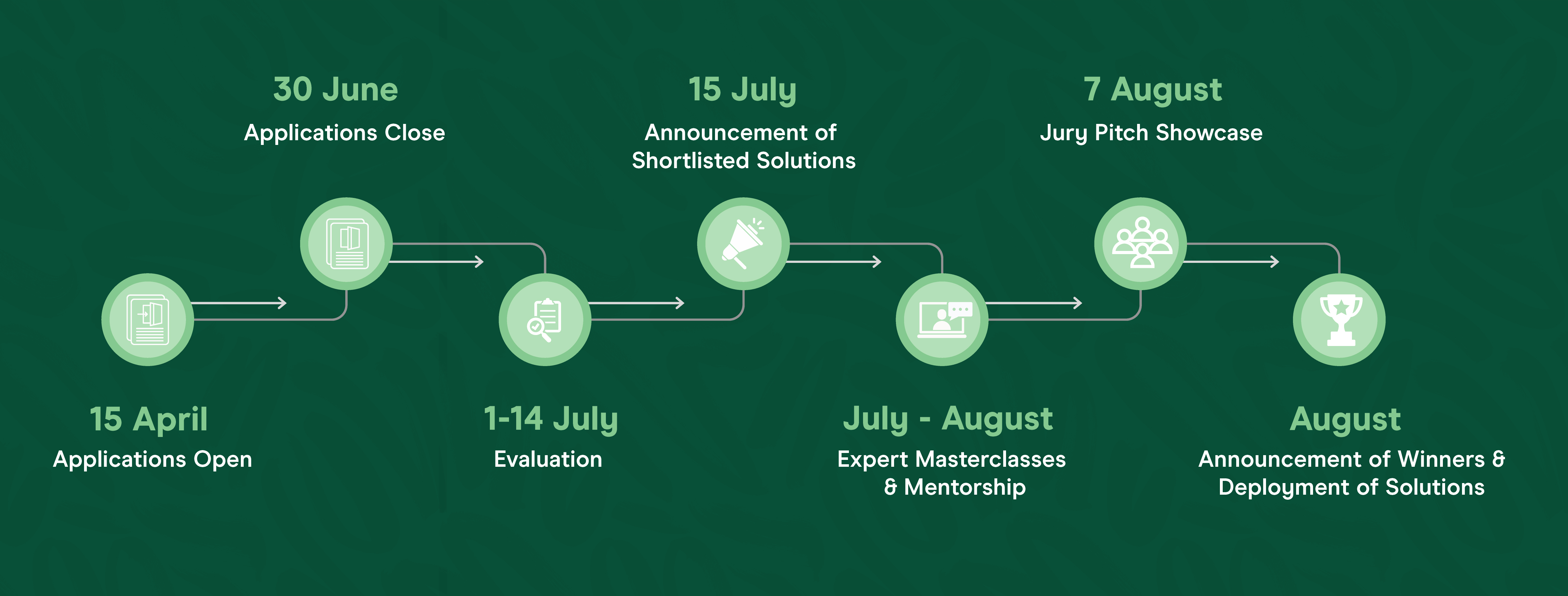
ENTICE 3.0
Problem Statements

Develop and demonstrate a non-lithium energy storage solution that can be deployed at distribution transformer (DT) voltage level that can operate individually or in coordinated fleets to reliably meet local peak demand.
The solution could include:
- Non-lithium chemistries (e.g., sodium-ion, zinc-based, flow batteries, metal-air) suited for DT-level deployment
- System designs that meet safety, cycle life, footprint, and operational requirements for DT-connected applications
- Integration architecture enabling seamless operation with DRE, grid signals, and coordinated BESS fleets
- Cost and performance validation frameworks to compare with lithium-ion alternatives under real-world conditions
- Demonstrating pathways for scaling, cost reduction, and improved performance parameters, showing how unit economics and key operational metrics (efficiency, cycle life, response times, availability) strengthen as project size and deployment volumes increase
Technical Readiness Requirement
Solutions must have:
- Field-demonstrated prototypes (TRL 6 or higher) for the core chemistry + system integration
- Ability to deploy a minimum viable operational unit at DT level for ENTICE pilot sites
- Prior validation of safety, thermal stability, cycle life, and footprint suitability for DT-connected use

Develop a hyperlocal, AI-driven forecasting platform that enables DISCOMs to accurately predict net grid demand by simultaneously modeling distributed renewable energy (DRE) generation—including rooftop solar and decentralized solar assets under schemes such as PM KUSUM—alongside weather-sensitive consumption patterns, particularly cooling loads driven by rising air-conditioner penetration.
The platform should deliver integrated forecasts of:
- Distributed Renewable Energy (DRE) Generation
- Rooftop solar systems
- Decentralized solar plants (e.g., KUSUM feeders)
- Net Grid Demand
-
The actual demand to be scheduled by the DISCOM at a Sub-station after accounting for DRE generation
By combining these components, the solution should produce an accurate estimation of the resulting net grid demand at the DISCOM or state level
The proposed system must integrate high-resolution, physics-based weather intelligence with advanced machine learning and hybrid physical modeling approaches to capture micro-climate variations (temperature, solar radiation, humidity, etc.) and their dynamic impact on both supply and demand. The solution should deliver reliable forecasts across multiple time horizons, enabling improved power procurement planning, reduced DSM penalties, and enhanced grid stability.
-
To apply for ENTICE 3.0, the organizations applying should fulfill the following criteria:
- Technology Readiness Level: Your solution should ideally be TRL 4 to TRL 6
- Revenue/sustainability model: You must have experience with fundraising, preferably ~25k – 50k USD or above, with a proven revenue or sustainability model in place
- Sector Relevance: The solution must address either or both focus areas within climate infrastructure
- Scalability & Innovation: The solution should have the potential for replication and scale across India (and potentially in other emerging markets) and it must show clear innovation
- Geographic Presence: Your firm must be based in India or have operations in India
- Team & Commitment: You must have a core team with complementary technical, business, and operational skills in place, with at least one full-time founder
The applications will be evaluated on five key parameters with weightages as mentioned below. The detailed evaluation criteria are available in the application form.
- Innovation & Technical Feasibility: 30%
Strength of the proposed solution’s technical architecture, level of innovation, and readiness for real-world deployment
- Cost-Effectiveness & Impact: 30%
Economic viability of the solution, including deployment costs, lifecycle economics, and operational efficiency
- User-Centric Design & System Compatibility: 15%
How easily the solution can be adopted within existing utility environments
- Market Potential and Traction: 10%
Clarity of commercialization strategy, strength of market demand, and the ability to scale deployment across utilities and similar markets
- Team, Partnerships & Financial Health: 15%
Expertise and track record of the team, strength of strategic partnerships, financial sustainability, and the credibility of the deployment and scaling roadmap

ENTICE 3.0 Distinguished Patron
-
 Govind IyerGovind IyerIndependent Director, Infosys & Member of the Board of Trustees, The Rockefeller Foundation

ENTICE 3.0 Jury Members
-
 Alok Kumar (Jury Chair)Alok Kumar (Jury Chair)Director General, All India Discoms Association (AIDA)
 -
 Ashish Khanna (Co-Jury Chair)Ashish Khanna (Co-Jury Chair)Director General, International Solar Alliance (ISA)
 -
 Abhishek RanjanAbhishek RanjanSenior Vice President and CEO, BSES Rajdhani Power Limited (BRPL)
 -
 Monika RathiMonika RathiHead of India, Vena Energy
 -
 Akshima GhateAkshima GhateDirector, RMI India Foundation
 -
 Debmalya SenDebmalya SenPresident, India Energy Storage Alliance (IESA)
 -
 Ruchira ShuklaRuchira ShuklaFounder and CEO, Green Marble
 -
 Sujith NairSujith NairCo-founder, Networks for Humanity
 -
 Raiyaan ShingatiRaiyaan ShingatiCo-Founder & Managing Partner, Transition VC
 -
 Rahul MunjalRahul MunjalFounder & Chairman, Hero Future Energies
 -
 Mirik GogriMirik GogriSustainability Investor, Spectrum Impact
 -
 Amit KhareAmit KhareProgram Manager, Sequoia Climate Foundation










Timeline